Catholic advocates have joined people affected by forced labour to call for practical assistance to workers at risk of extreme labour exploitation. Source: ACAN.
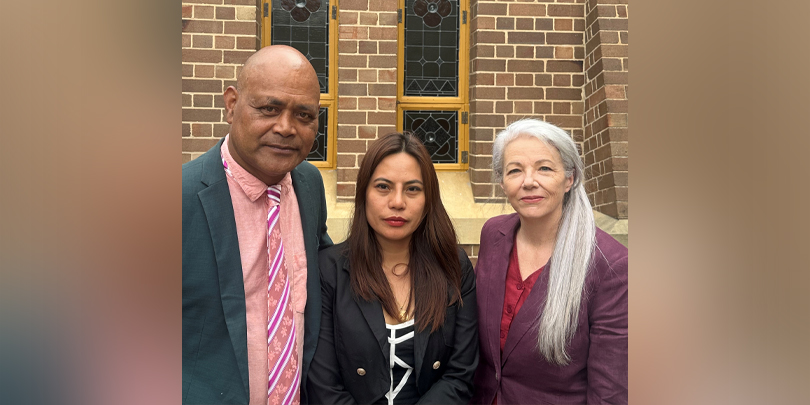
Moe Turaga, Jessa Royupa and Alison Rahill made the call after new research showed only one per cent of modern slavery reports to the Australian Federal Police result in convictions.
“This research confirms what people working on the ground in forced labour have known for years – that vulnerable workers in Australia are stuck in a law enforcement limbo,” said Mr Turaga, a lived experience advisor for Domus 8.7, Australia’s only independent modern slavery remediation service.
“Police can only run prosecutions with willing witnesses. Even then, these cases take years to get to court. Meanwhile, workers are crying out for help to transition from exploitation to fair work. They just aren’t getting the support they need.
“Migrant workers are the most at risk of forced labour in Australia, but it is almost impossible for them to stand up for their rights. For a migrant worker, the most likely result of calling police is that they will be sent home or deported – broke, broken, or worse.”
The new research, produced for the Office of the Australian Anti-Slavery Commissioner, found there were only 41 convictions of modern slavery and human trafficking between 2004 and 2025 from more than 3000 reports made to the Australian Federal Police.
Jessa Royupa is a Filipino attorney whose brother Jerwin died shortly after being recruited to a sham training scheme at a winery in NSW in 2019. Ms Royupa said fear of police made it even more difficult for Jerwin to complain about his working conditions.
“Jerwin was definitely intimidated by his employer, who got angry when Jerwin asked for his allowance,” Ms Royupa said.
“He (Jerwin) was dependent on his employer for work, for transport, for accommodation, but he also had a fear of the authorities, and when he was being told and abused verbally that he was going to get taken, he was going to be deported, he was going to be taken to the police.”
Domus 8.7 has supported the Royupa family since 2019.
Domus 8.7 co-founder Alison Rahill said the latest research is a compelling reason that workers need remedy from forced labour to exist beyond the criminal justice system.
“People leaving forced labour need safety, accommodation, access to health care, migration advice, and a safe job that pays fairly,” Ms Rahill said.
“These are supports that mainstream community and social services are in a much better position to provide than police.”
FULL STORY
Practical remedy for forced labour victims in law enforcement limbo (ACAN)