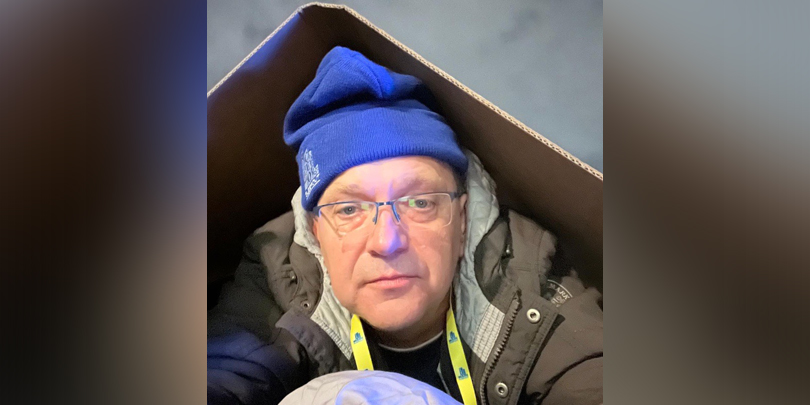
Sleeping rough for a single night is an inadequate simulation of homelessness, but it can still leave a mark, writes Australian Cathoilc University’s vice-chancellor Zlatko Skrbis.
It’s still dark at the Roma Street Parkland in Brisbane, a dry winter’s night in mid-June. At about 4am, the city begins to wake, and you hear it before you see it.
Around me, CEOs are disassembling their shelters made of cardboard, wrestling out of sleeping bags as they yawn and raise their heads. I do the same.
By 5am, most of us have folded our makeshift dwellings into flat sheets of carton.
The switch flips quickly. In a moment, we are once again busy people, checking our watches and phones, working out where we need to be at the beginning of another day of meetings and decision-making.
That’s where I see him. A lone gentleman, rugged up and sleeping under the light of the bus station.
A real version of the type of person that I and other participants in the Vinnies CEO Sleepout had spent one night trying to understand and imitate.
This juxtaposition was really quite stark to me. I had an Uber coming, a hot coffee and a warm bed waiting for me, as well as the comfort and security of home and work.
He would soon wake to the same morning he had likely woken to the day before, and the one before that, without much comfort or a safety net, without the certainty that most of us take for granted.
This was my first CEO Sleepout, and I want to be honest about what the night was. My one night of sleeping relatively rough was nothing like real homelessness.
There is a word for a thing that takes on the likeness of another thing without its substance – a simulacrum.
This was made famous by the French sociologist Jean Baudrillard, and when I saw the man at the bus station, I understood that the night I’d just spent in central Brisbane was exactly this.
The thought sat with me uncomfortably as I jumped into my Uber and slipped back into my life.
And yet the night was not nothing.
The St Vincent de Paul Society recently announced that this year’s event raised more than $10 million nationally – a record, at a time when the demand for homelessness services continues to climb.
The not-for-profit organisation, which has long had a close connection with ACU, is clear that the annual sleepout doesn’t aim to replicate homelessness.
Rather, it hopes to “build understanding and turn that into real action” for the people it supports.
This is where I think the real power of such an event lies.
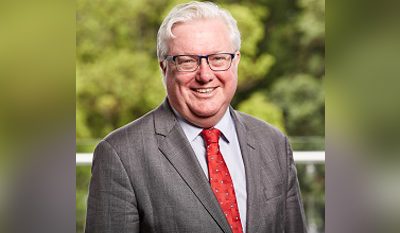
Professor Zlatko Skrbis is vice-chancellor and president of Australian Catholic University.
FULL STORY
What one night on cardboard can and can’t do, writes ACU’s Professor Zlatko Skrbis (The Catholic Leader via ACU)