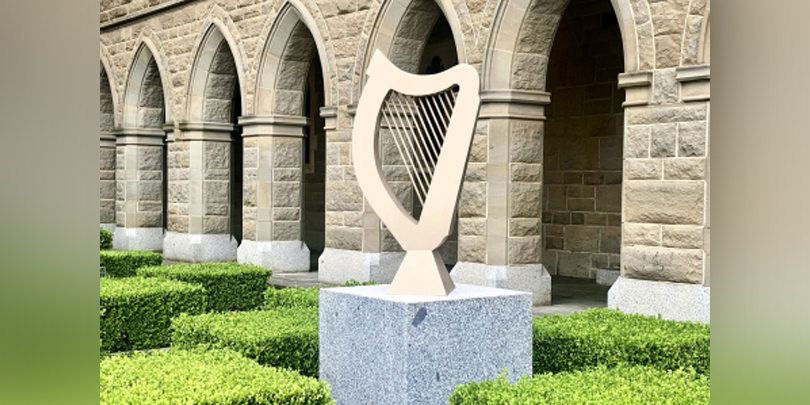
The Central Victorian Irish Association has gifted an Irish harp statue to Sacred Heart Cathedral, Bendigo, symbolising the Irish migrants whose faith, culture and labour helped build the Church in the Sandhurst Diocese. Source: Sandpiper.
The Irish harp, or cláirseach (pronounced KLAH-r-shukh), is the national emblem of Ireland. Long before it appeared on passports and coins, it belonged to a sacred world of memory and meaning. In Gaelic society, harpers were honoured as custodians of story and soul; their music binding community, history and belief.
For Irish Catholics, the harp also carries the weight of endurance. When colonial rule sought to suppress the Irish language, culture and faith, harpers and their instruments were targeted, an attempt to silence the spirit of a people.
Yet the harp survived and was reclaimed as a sign of hope and defiance, “new strung” and heard again. Its familiar form, shaped by the historic harp preserved at Trinity College Dublin, remains the model for Ireland’s official seal today.
Set within the Bendigo cathedral grounds, the harp speaks to Sandhurst Diocese’s own foundations.
In the late 19th century, Irish priests, religious and lay people crossed oceans to serve growing communities across Sandhurst. They built churches and schools, celebrated the sacraments, and carried faith into goldfields towns and rural parishes alike. Their legacy endures not only in stone and timber, but in the lives and communities that followed.
Today, the Irish may no longer be a dominant migrant group, yet Irish blood runs quietly through many veins across the Diocese.
This harp stands as a reminder of those forebears, of culture kept alive, faith handed on, and a people who helped shape the Church we inherit.
The harp is installed on the High Street side of the Cathedral, in gardens that remain open to the public throughout the development of Cathedral Square.
FULL STORY
Strings of Faith: The Irish Harp and the Story It Carries (Sandpiper)