The growing influence of artificial intelligence is prompting society to ask profound questions about what it means to be human, according to technology ethicist Victoria Lorrimar. Source: The Catholic Weekly.
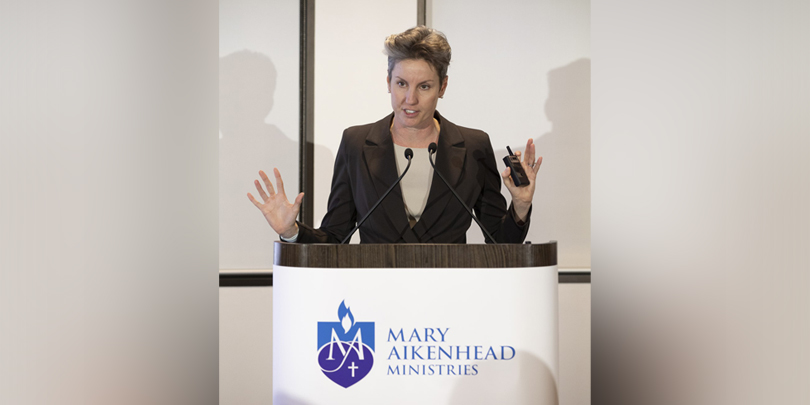
Delivering the fourth annual oration on the feast of Venerable Mary Aikenhead at Australian Catholic University in North Sydney, she contended that modern culture is increasingly dominated by a mindset of optimisation.
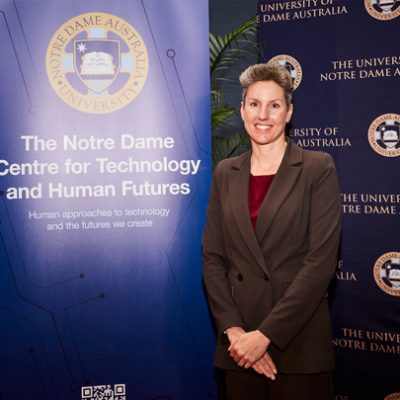
Associate Professor Lorrimar is the director of the Centre for Technology and Human Futures at the University of Notre Dame Australia. Rather than seeing people as beings created for relationship, she said, contemporary society often views individuals as projects to be measured, improved and maximised.
Drawing on Pope Leo XIV’s recent encyclical Magnifica Humanitas, she argued that this danger arises when efficiency becomes society’s highest value.
“When efficiency becomes the ultimate measure of value, human beings are tempted to see themselves as a project to be optimised, rather than as persons called to relationship and communion,” she said.
Her address ranged widely across emerging technologies, biohacking, AI, and transhumanist visions of the future, but returned repeatedly to the theme of human dignity.
Associate Professor Lorrimar began by pointing to recent cultural trends reflected in terms such as “biohacking”, “aura farming” and “rage baiting”, arguing that each of these reveals a preoccupation with self-improvement, engagement metrics, and optimisation.
She cautioned that an increasing reliance on data and measurement can subtly reshape human values. Referring to the American philosopher C. Thi Nguyen’s concept of “value capture”, she explained how people often begin by measuring success using simplified metrics and then allow those metrics to define what matters.
To illustrate her point, she recounted her own experience of becoming fixated on smartwatch step counts. What began as a desire to improve her health eventually became an obsession with meeting daily targets.
After a technical malfunction erased a day’s activity data, she realised she was prepared to sacrifice sleep and wellbeing simply to maintain a digital streak. The episode, she said, showed her how easily deeper values can be replaced by measurable goals.
The same dynamic, she suggested, can be seen in broader technological culture, where optimisation increasingly influences how society understands both individuals and humanity itself.
Such movements, she argued, often assume that human beings are fundamentally problems to be solved or systems to be upgraded.
Against this backdrop, she examined the growing enthusiasm surrounding AI. While acknowledging the remarkable capabilities of current systems, she warned against both utopian and catastrophic narratives.
FULL STORY
People are not data to be optimised, says expert (By Michael Cook, The Catholic Weekly)