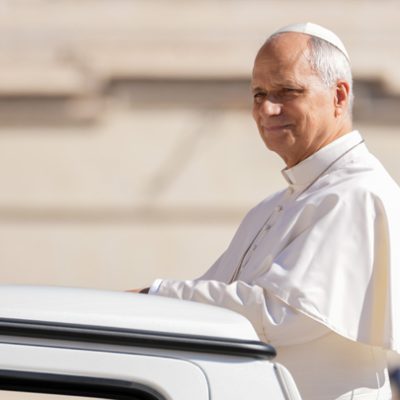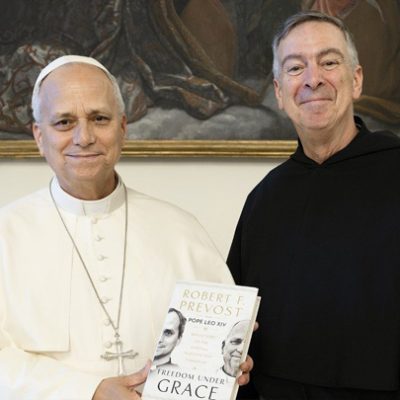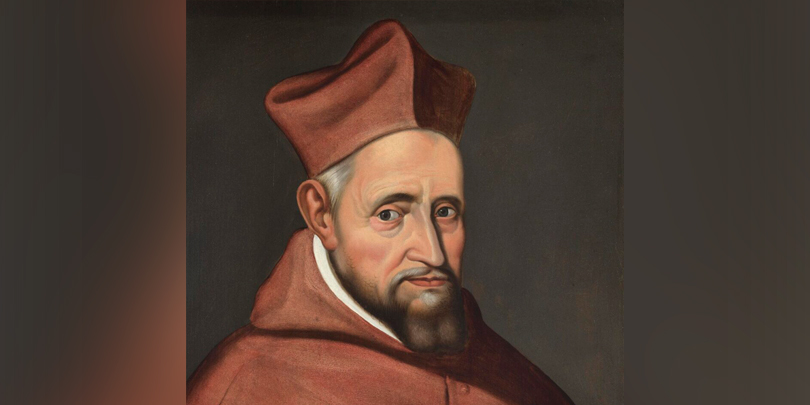
Pope Leo XIV celebrated his 71st birthday on Monday, but in Vatican City the more significant celebration came yesterday on the Pope’s “name day”, the feast of St Robert Bellarmine. Source: OSV News.
Born Robert Prevost, the Pope shares his given name with the 17th-century saint, a Jesuit cardinal and Doctor of the Church who died on September 17, 1621. In southern Italy, it is common to celebrate one’s “onomastico”, or name day, in addition to one’s birthday.
For Pope Leo XIV, the coincidence of a birthday and a name day falling in the same week offers a moment of double celebration, as well as some surprisingly relevant lessons on Church governance, administration, and holiness for a pope from the saint whose name he has borne for 71 years.
September 17 is and will be an official holiday of Vatican City State for the duration of Pope Leo XIV’s pontificate, following a pattern set by his predecessors.
The feast of St George, April 23, was observed as a holiday under Pope Francis, born Jorge Mario Bergoglio, while the feast of St Joseph, March 19, held that place during the pontificate of Pope Benedict XVI, born Joseph Ratzinger.
St. Bellarmine, canonised in 1930 and declared a Doctor of the Church in 1931, was one of the towering theological figures of the Counter-Reformation. Born in 1542 into a prominent Tuscan family and a nephew of a pope, he entered the Society of Jesus shortly before his 18th birthday.
He studied philosophy and theology in Padua and Louvain, focusing on the works of St. Thomas Aquinas and the Church Fathers, and was ordained a priest in 1570.
As the first Jesuit to teach at Louvain, he lectured for seven years before returning to Rome in 1576. There he taught at the Roman College, now known as the Pontifical Gregorian University, where he produced a three-volume defence of Catholic teaching against the Protestant heresies of the era, work that shaped Catholic thought in the years following the Council of Trent.
St Bellarmine went on to serve as spiritual director to Jesuit students at the Roman College, where he guided St Aloysius Gonzaga, before becoming Jesuit provincial and cardinal-archbishop of Capua.
Pope Clement VIII named him papal theologian, a consultor to the Holy Office and rector of the College of Confessors at St Peter’s Basilica, later appointing him Examiner of Bishops.
He also mediated theological disputes over grace and was drawn into the controversy surrounding Galileo’s teaching that the Earth was not the centre of the universe. In his later years, he turned to devotional writing, producing works including On the Art of Dying Well.
He died in Rome on September 17, 1621.
FULL STORY
Why Sept 17 is a holiday in Vatican City (By Courtney Mares, OSV News)