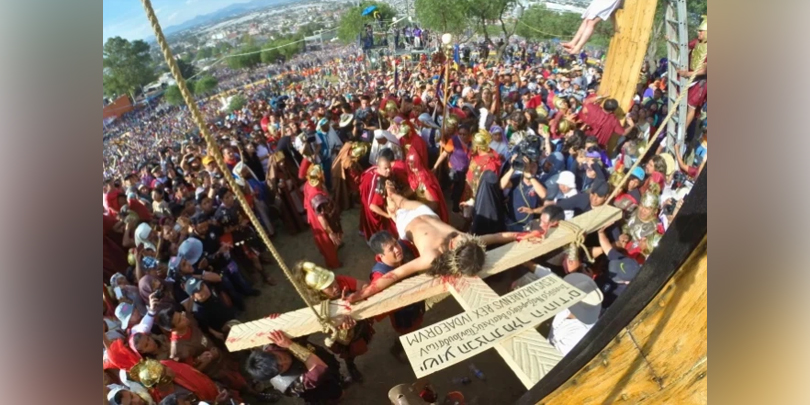
A popular representation of the passion, death, and resurrection of Christ, held every Holy Week in Mexico City, has been declared a Cultural Heritage of Humanity by the United Nations Educational, Scientific and Cultural Organisation. Source: CNA.
The decision was made during a UNESCO meeting in New Delhi, India, where the nomination of the Iztapalapa Way of the Cross was reviewed and approved.
Speaking at the event, Edaly Quiroz, deputy director of Mexico’s National Institute of Anthropology and History, said that Holy Week in the Iztapalapa sector of Mexico City is not merely a theatrical performance but a manifestation “of unity, faith, and resilience that brings together thousands of people in a collective exercise of memory, identity, and participation”.
On its website, UNESCO states that this list includes “practices, knowledge, and expressions that communities recognise as part of their cultural identity” and emphasises the need to protect them for future generations.
Juan Pablo Serrano, custodian of the image of the Lord of the Little Cave in the Iztapalapa Cathedral, said the tradition is closely linked to the origin of the image and a 19th-century promise made by the community.
He recounted that in 1687, an image of Christ was being transported from Oaxaca, in southern Mexico, to Mexico City for restoration. During the journey, those carrying it rested in a cave in the Hill of the Star, and when they tried to resume their trip, “they could no longer move the image”.
“It was understood that the image representing Christ in the tomb wanted to remain there. [Being in a cave] a very particular devotion began to develop,” he said.
Mr Serrano said the direct connection with the depiction of the Stations of the Cross arose in 1833 during a cholera epidemic. Faced with the high death toll, the inhabitants carried the image in procession and asked for Christ’s intercession. After several days of prayer, the plague ceased, an event that was interpreted as a miracle.
Following that event, the community vowed to reenact the passion, death, and resurrection of Christ every year as a sign of gratitude, and each year the tradition has grown, both in the number of participants and the audience. In Holy Week 2025, it drew approximately two million people.
FULL STORY
Representation of the Way of the Cross in Mexico recognized as UNESCO heritage site (By Diego López Colín, CNA)