The Vatican’s top diplomat to the United Nations has condemned modern and historical slavery, while countering a “partial narrative” in a newly adopted UN resolution denouncing the transatlantic slave trade as “the gravest crime against humanity”. Source: OSV News.
The resolution also called for reparations by member states to affected nations.
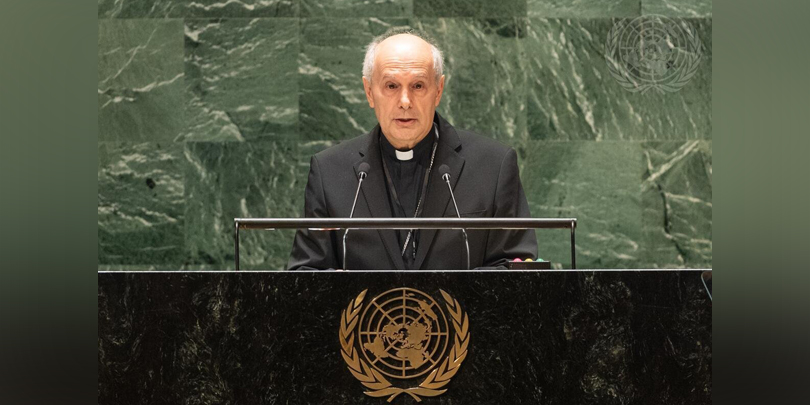
Archbishop Gabriele G. Caccia, the Holy See’s permanent observer to the UN, delivered a statement on the issue on Wednesday, observed as the International Day of Remembrance of the Victims of Slavery and the Transatlantic Slave Trade.
Inaugurated in 2008, the commemoration marks the date in 1807 when the United Kingdom legally abolished the slave trade, which saw some 12 million to 20 million Africans enslaved in various Western nations, including the US, over a period of four centuries.
This year, the international observance saw the passage of a resolution led by Ghana – one of several modern African nations from which millions of enslaved people were transited – declaring “the enslavement of Africans as the gravest crime against humanity.”
In particular, the resolution cited the slave trade’s “definitive break in world history”, along with its “scale, duration, systemic nature, brutality and enduring consequences that continue to structure the lives of all people through racialised regimes of labour, property and capital”.
The resolution passed with 123 votes in favour and three nations – Argentina, Israel and the United States – voting against it. Another 52 member states, including the United Kingdom and the nations of the European Union, abstained.
“The Holy See unequivocally condemns slavery, including in its modern forms,” Archbishop Caccia said in his address. “The call for remembrance today is a reminder to all states of their duty to uphold historical truth and ensure legal accountability.”
Archbishop Caccia, whom Pope Leo recently appointed the next papal ambassador to the US, also noted that the UN resolution “contains a partial narrative,” one that “regrettably, does not serve the cause of truth.”
Specifically, the resolution text stated that papal bulls such as Dum Diversas in 1452 and Romanus Pontifex in 1455 had “authorised the reduction of African persons to ‘perpetual slavery’.”
However, in a March 2023 statement, the Vatican formally distanced itself from those two bulls, as well as the 1493 Inter Caetera, in its official repudiation of the so-called “Doctrine of Discovery”.
That statement stressed that “historical research clearly demonstrates” the bulls, “written in a specific historical period and linked to political questions, have never been considered expressions of the Catholic faith”.
FULL STORY
Vatican ‘unequivocally’ condemns slavery, counters ‘partial narrative’ in UN resolution (By Gina Christian, OSV News)