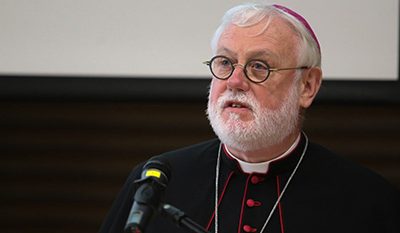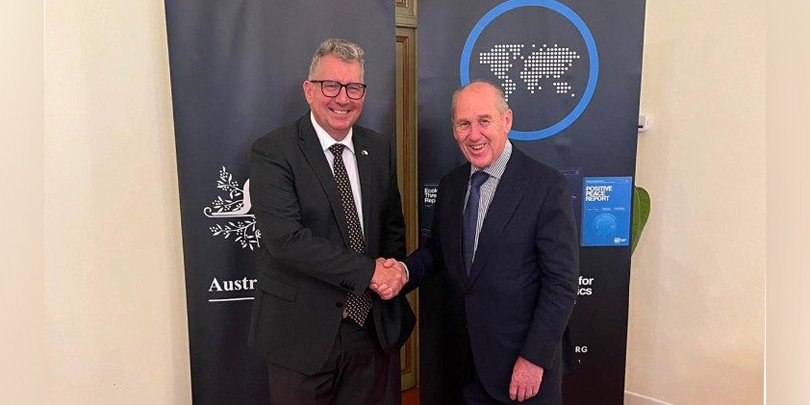
The Australian embassy to the Holy See hosted the presentation of the 2026 Global Peace Index by Australian philanthropist Steve Killelea, who discussed how to invest in peace rather than war. Source: Vatican News.
For the past 12 years, peace around the world has deteriorated: more countries are engaged in external conflicts, the number of drone attacks has increased by more than 11,500 per cent between 2018 and 2025, and the number of people killed in domestic fighting has seen a six-fold rise since 2007.
This data exists thanks to the Global Peace Index. Part of the Institute for Economics and Peace, founder and executive chair Mr Killelea created the index to give people, governments, and countries the information they need to concretely work for peace in the world.
“Some people wonder why this is important. But if you can’t measure something, can you truly understand it?”, Mr Killelea said.
First launched in 2007, the Global Peace Index (GPI) is an important piece of research on measuring global peacefulness. It brings three categories together to create the complete index—militarisation, ongoing conflict, and internal safety and security.
Before the GPI, a standardised, comprehensive index that listed countries by peacefulness did not exist. Without this proper measuring, Mr Killelea begged the question, “how do you know whether your action is either helping or hindering in achieving your goals? You simply don’t.”
Hosting the presentation of the 2026 GPI in Rome on Monday, Australia’s ambassador to the Holy See, Keith Pitt, stressed the important work Mr Killelea has been doing with the GPI over the past 19 years.
Its data outlines a rise in the number of conflicts around the world and the founder pointed out a shift in how wars ended. In the 1970s, 23 per cent came to a close with a peace agreement. Decades later in the 2010s, that dropped to only 4 per cent.
Mr Killelea noted that governments must begin working out how to form alliances to achieve peace. The key to this, he said, was “governments waking up and realising that you can invest in war, but that does not actually create peace.”
He offered three ways to do this. First, more diplomacy. Second, when dealing with localised conflict, it is important to understand the grievances and address them. Third, better people’s livelihoods. “If people can see their livelihoods improving, they’re a lot more likely to not want to fight or try and overthrow the government,” Mr Killelea said.
FULL STORY
2026 Global Peace Index: We must invest in peace, not war (By Kielce Gussie, Vatican News)