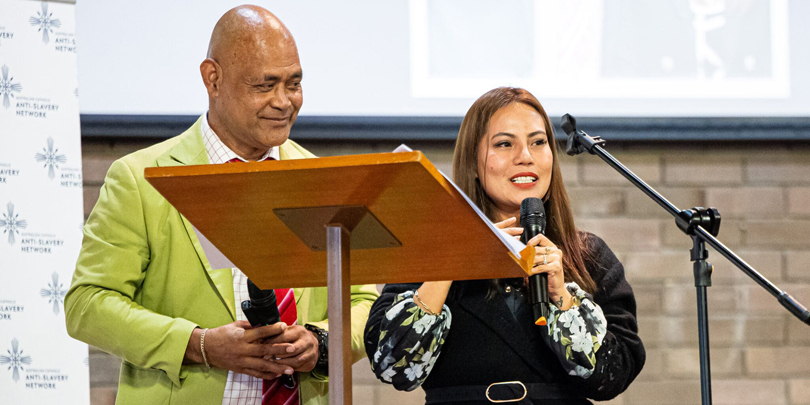
Anti-modern slavery advocate Jessa-Joy Royupa delivered a powerful address condemning the practice in Australia at a dinner hosted jointly by the Archdiocese of Sydney’s Justice and Peace Office and the Australian Catholic Anti-slavery Network. Source: Catholic Weekly.
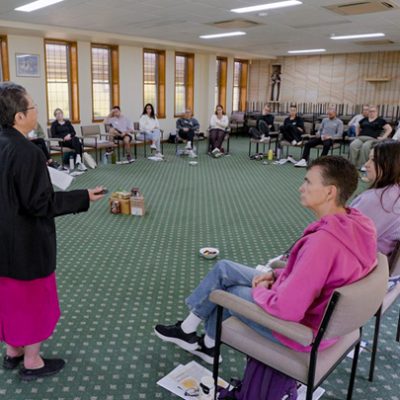
Held at All Saints Parish Hall at Liverpool in Sydney’s south-west, the annual tri-diocesan social justice dinner brought together about 70 supporters from across the Archdiocese of Sydney and Dioceses of Broken Bay and Wollongong, including faith and civic leaders. Ms Royupa and slavery survivor Moe Turaga spoke about the hallmarks of modern slavery and its devastating impact on victims and their families.
Ms Royupa’s brother, Jerwin Royupa, died in mysterious circumstances in regional New South Wales in 2019, just over a month after arriving in Australia to work at a winery. He entered Australia on a subclass 407 training visa, which allows entry for workplace training. Having recently completed an agriculture degree, he hoped to gain experience before returning to the Philippines to run his own farm.
Although entitled to receive $134.92 a month while working 10 hours a day, six days a week under the visa arrangement, Ms Royupa said her brother was working much longer hours in harsh conditions.
“His sponsor took Jerwin’s passport and said he wouldn’t be paid for six months to offset the cost of bringing him to Australia,” she said.
“Five weeks later, he exited a car travelling at more than 100 kilometres an hour and died in hospital the next day.”
The 21-year-old’s death and the Royupa family’s advocacy led to Australia’s first coronial inquest examining modern slavery. Federal police are now investigating possible criminal offences.
Ms Royupa said exploited migrant workers often do not feel able to approach Australian authorities because their passports have been confiscated, they fear deportation, or they worry about returning home having failed to provide for their families.
Archbishop Anthony Fisher OP praised the work of Domus 8.7, the archdiocesan agency named after United Nations Sustainable Development Goal 8.7, the international commitment to end forced labour, modern slavery and human trafficking. He also praised ACAN before recalling the story of an enslaved woman who sought his help.
“She’d come to Australia with a family as a nanny, hoping for a better life for herself in Sydney,” he said. “But on arrival, her passport was confiscated by her employers – so-called – who required that she work long hours with little or no recreation and for no wages.”
The archbishop also reflected on Pope Leo XIV’s first encyclical, Magnificat Humanitas, which warns of the dangers posed by emerging technologies, including their potential to deepen inequality and exploitation.
NSW Anti-slavery Commissioner James Cockayne told guests the United Nations estimates there are about 50 million people living in modern slavery worldwide, including about 41,000 in Australia.
FULL STORY
Sydney’s dioceses come together to combat modern slavery (By Tara Kennedy, The Catholic Weekly)