Artificial intelligence may be a defining technology of the decade, but US bioethicist Jason T Eberl has warned it risks undermining human dignity and deepening social inequality. Source: The Catholic Weekly.
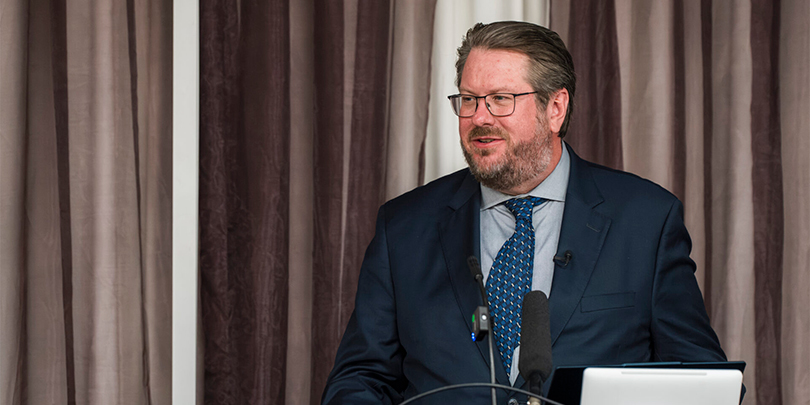
Delivering the 2026 Plunkett Lecture at St Vincent’s Clinic in Sydney on April 8, Professor Eberl addressed philosophical and ethical concerns around the use of artificial intelligence and biotechnology to promote “human enhancement”.
He focused on transhumanism, a movement that promotes reshaping human nature through technology and prioritises what it calls “morphological freedom” from ageing, disease and other aspects of the human condition.
“While I do think some modern forms of human enhancement could be conducive to human flourishing, I also think there are significant practical and ethical limits to pursuing these forms of enhancement,” he said.
“Transhumanism is philosophically and theologically, from both a broader Christian perspective and Catholic perspective, problematic.”
Professor Eberl is the Hubert Mäder Chair in Bioethics, Professor of Philosophy, and Director of the Albert Gnaegi Center for Bioethics at Saint Louis University.
He drew on the writings of St Thomas Aquinas to challenge transhumanist assumptions, arguing that human beings are not reducible to their capacities or technological potential.
“Aquinas conceives of us not as ghosts in machines, not as souls inhabiting bodies, but as rational animals, as embodied beings where our souls are intertwined, informing the matter that makes up our bodies,” he said.
“He recognised that the fundamental good for us consists of our flourishing, which is the fulfilment of our shared nature as living, sentient, social and rational animals, and becoming the most perfect person we can be – but not the most complete, which can only happen through the grace of God.”
Professor Eberl warned new forms of social inequality were being presaged in debates around disability and biotechnology, and that technologies such as prenatal implantation and in-vitro fertilisation can contribute to a form of “positive eugenics” – marginalising those who cannot access them, refuse them, or lack the capacity to use them.
“They are exercises in autonomy where the parents make choices to prevent their future children from experiencing suffering or potential impairment,” he said.
“These technologies, among many other innovations, are where I think this concept of positive eugenics is coming back.
“Because how can we square the circle of valorising the enhancement of certain human capacities without disvaluing the lives and experiences of persons with disabilities? This is a particular form of injustice already present in these technologies.”
FULL STORY
AI risks undermining human dignity, bioethicist warns (By Alex Woolnough, The Catholic Weekly)