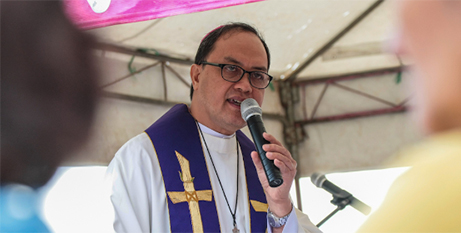
A Filipino parish in northern Metro Manila, under the jurisdiction of Kalookan Bishop Cardinal Pablo Virgilio David, has drawn criticism over alleged animal cruelty in an Easter Sunday tradition. Source: The Tablet.
The Diocesan Shrine of the Immaculate Conception in Malabon City, a century-old church, used a pigeon to remove a black veil from a statue of the Virgin Mary on Easter Sunday. Its wings restrained, the pigeon was then tied to balloons and released into the air.
The ritual was part of a Filipino Easter tradition called the Salubong (“Encounter”), where Mary “meets” her risen son during a dawn procession.
Traditionally, other Filipino parishes select a child to unveil Mary’s statue, but the Immaculate Conception Shrine said it has used a pigeon for decades because it is “a safer and less distressing alternative”.
Cardinal David, 67, said he was unaware of the act of cruelty. He objected to the practice, “noting that it is not only harmful to the animal but also to the environment, especially to the marine life that may ingest deflated balloons”, according to a statement from the Kalookan Diocese.
The diocese also said the parish “has committed to discontinue this practice”.
In future Salubong celebrations, the parish said it will no longer release balloons into the air and will release the pigeon immediately after the Blessed Mother is unveiled.
However, the Philippine Animal Welfare Society (PAWS) refused to accept the diocese’s apology. It said the diocese “seems to miss the point” that the act of fastening the bird’s wings, which inflicted “extreme suffering”, is a crime under Philippine laws.
“The next time this happens, we will file a case,” said PAWS executive director Anna Cabrera in a statement on April 8.
Based on the country’s Animal Welfare Act of 1998, the torture or maltreatment of animals is punishable by imprisonment of six months to two years, or a fine up to the equivalent of $A 2500.
FULL STORY
Filipino parish accused of animal cruelty in Easter Sunday tradition (By Paterno R. Esmaquel II, The Tablet)