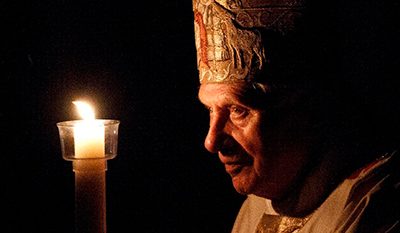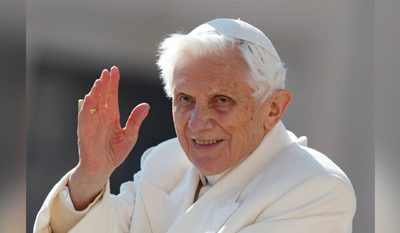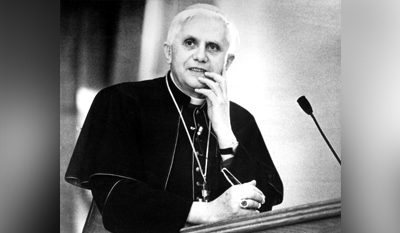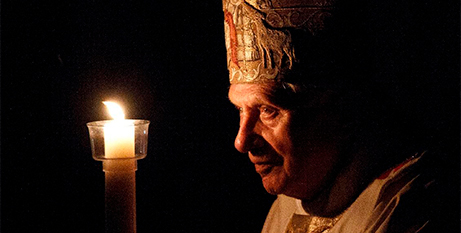
Of all the discourses he delivered in his nearly eight-year pontificate – with the exception of his 2013 resignation – Pope Benedict XVI’s September 12, 2006, address at the University of Regensburg sparked unprecedented global reaction. Source: Catholic Review.
During his address, the Pope cited the 14th-century Byzantine Emperor Manuel II Paleologus’ views about the relationship between religion and violence, particularly in Islam: “Show me just what Mohammed brought that was new, and there you will find things only evil and inhuman, such as his command to spread by the sword the faith he preached.”
Although Pope Benedict prefaced the quote by saying the emperor spoke with “a startling brusqueness” that he and modern audiences found “unacceptable,” it did little to quell the controversy, which sparked protests worldwide.
As criticism mounted, Cardinal Tarcisio Bertone, then Vatican secretary of state, issued a statement saying that while Pope Benedict regretted that the quote “sounded offensive to the sensitivities” of Muslims, he “did not mean, nor does he mean, to make that opinion his own in any way.”
“He simply used it as a means to undertake – in an academic context, and as is evident from a complete and attentive reading of the text – certain reflections on the theme of the relationship between religion and violence in general, and to conclude with a clear and radical rejection of the religious motivation for violence, from whatever side it may come,” Cardinal Bertone wrote.
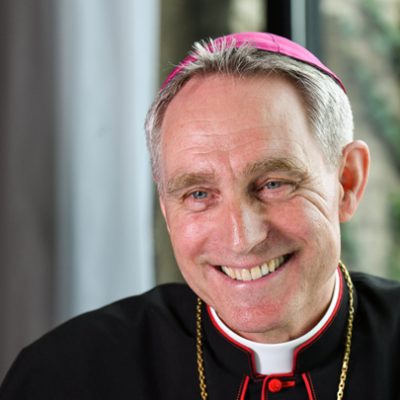
In an interview with OSV News on September 4, German Cardinal Gerhard Müller, former prefect of what was then the Congregation for the Doctrine of the Faith, said the address was “a scientific presentation of these problems of the link between faith and reason”.
The cardinal, who was present at the speech as bishop of Regensburg, recalled that it was “a very great speech” and that the focus of Pope Benedict’s address was to highlight that faith and violence were incompatible “because Jesus suffered for us to overcome violence and there’s no possibility for violence, for murders, (for) killing in the name of God.”
“It must be absolutely clear that it is against the will of God that in his name people are violated or killed or anything done bad against them,” Cardinal Müller said.
Cardinal Müller said the ensuing accusations that the Pope spoke against Islam were “a misinterpretation”.
“If you read the text, and you know him and all his theology, this interpretation was absolutely impossible.”
Reflecting on the 20th anniversary of Pope Benedict’s speech, Fr Roberto Regoli, president of the Joseph Ratzinger-Benedict XVI Vatican Foundation, said the controversy surrounding the speech was “overcome” a decade ago and that, in today’s world, it has proven prophetic.
“What was the issue at stake for Benedict XVI in that masterful address at the university? The incompatibility that must exist between religion and violence – it is a radical incompatibility. And so, that speech of Ratzinger’s remains profoundly relevant today,” Fr Regoli said.
FULL STORY
2 decades after Regensburg, Church leaders say Pope Benedict’s speech was misinterpreted but prophetic (By Junno Arocho Esteves, OSV News via Catholic Review)