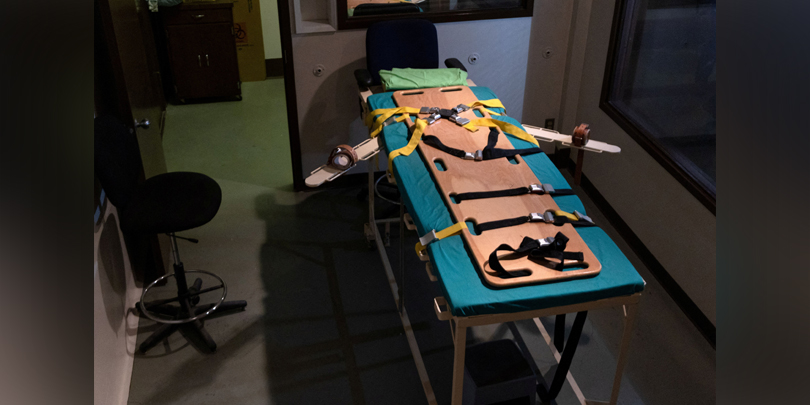
Catholic leaders in South Korea have renewed their call for the abolition of the death penalty and urged lawmakers to build a penal system that protects human dignity, public safety, and the possibility of rehabilitation. Source: UCA News.
The call was made during an annual seminar on abolishing the death penalty, held on September 17 at the National Assembly Members’ Office Building in Seoul.
The event was organised by the subcommittee on the abolition of the death penalty under the Justice and Peace Committee of the Catholic Bishops’ Conference of Korea and Democratic Party lawmaker Lee Hak-young.
Church leaders and abolition campaigners said South Korea’s long moratorium on executions shows that society can maintain order without resorting to state killing.
They argued that the next step should be to remove capital punishment from the statute books and develop sentences that protect society while respecting life.
Former Mongolian president Tsakhia Elbegdorj, now a member of the International Commission Against the Death Penalty, told participants that Mongolia’s experience showed that abolition did not lead to a surge in crime.
“Although the death penalty was abolished in Mongolia, contrary to the concerns of many, the incidence of crime has actually decreased,” Mr Elbegdorj said.
He added that governments should respond to public fear with evidence, dialogue and justice reforms rather than executions.
Mr Elbegdorj said countries debating abolition often struggle when serious crimes dominate public attention.
However, he said political leaders must help citizens understand that justice systems can punish grave crimes without adopting irreversible measures.
Kim Dae-geun, a researcher at the Korean Institute of Criminology and Justice, warned that replacing executions with life imprisonment without parole could raise constitutional concerns because it would permanently deny prisoners any possibility of review, rehabilitation or reintegration.
He proposed retaining life imprisonment under existing law or introducing life imprisonment with a minimum period before parole review.
Bishop Simon Kim Joo-young, who chairs the bishops’ Justice and Peace Committee, said the campaign against capital punishment should be rooted in respect for human rights beyond religious boundaries.
“I hope we become a society that respects human rights regardless of religion. If many people share the same will, the day of the abolition of the death penalty will be brought forward,” he said.
FULL STORY
Korean Catholic Church seeks abolition of death penalty (UCA News)