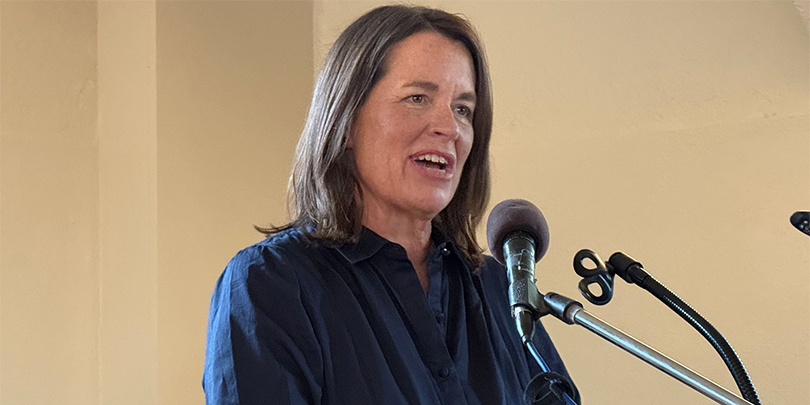
The discussion on artificial intelligence often focuses on regulation and the responsibility of “Big Tech” and government to control it, but at the Helder Camara Lecture in Melbourne, Kim Daniels suggested a different starting point: we are all called to actively take responsibility for how AI is used. Source: Melbourne Catholic.
Professor Daniels is the director of the Initiative on Catholic Social Thought and Public Life at Georgetown University in Washington.
Drawing on Pope Leo XIV’s encyclical Magnifica Humanitas, Professor Daniels said questions about the technology and its trajectory are for families, schools, workplaces and communities to grapple with.
“He’s calling us to broad participation in public life, grounded in our responsibility to safeguard the human person,” she said. “The future of human dignity in an age of AI depends on each one of us having a say in how this technology is built and used.”
Catholics are uniquely positioned to widen this conversation, Professor Daniels said, bringing a rich moral vocabulary drawn from intellectual and social tradition, and a worldwide institutional presence of over 1.4 billion Catholics, which lets the Church recognise technology’s human impact and gives greater weight to its political voice.
Professor Daniels used the lecture at the University of Melbourne’s Newman College on October 15 to propose three ways we can advance human dignity by responding to Pope Leo’s call to be actively involved in public life: “Widen the table” to ensure real democratic participation with citizens, communities and institutions all making decisions about AI; “strengthen the institutions that hold us together and give us a public voice”; and protect human work, honouring “the care, the judgment, the gifts that only people can bring”.
At the heart of Magnifica Humanitas is the conviction that human dignity is expressed in public life through participation, Professor Daniels said.
“We are agents with a voice, and our dignity includes a say in what shapes our lives,” she said.
“Pope Leo says that a more moral AI is not enough if that morality is just determined by a few. What’s needed, he says, is a more active political involvement. Otherwise, he warns those who control AI will impose their own moral vision, which will become the invisible infrastructure of these systems.”
FULL STORY
Helder Camara Lecture: AI, Pope Leo and the future of human dignity (Melbourne Catholic)