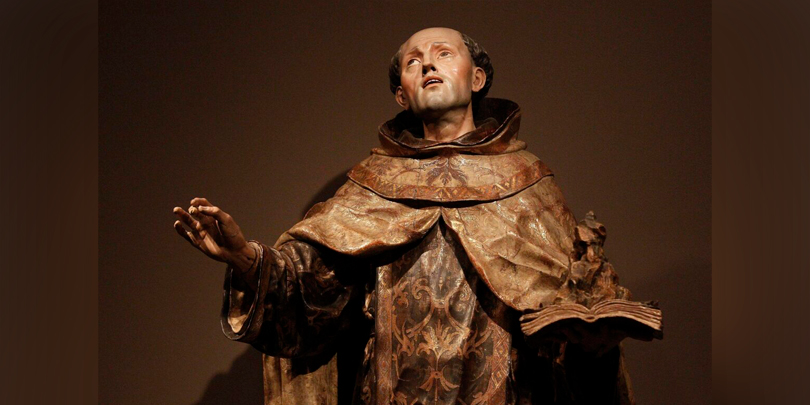
Spanish Catholics have welcomed new public interest being shown in St John of the Cross, on the twin anniversary of his 1726 canonisation and proclamation as a doctor of the Church on August 24, 1926. Source: OSV News.
“This saint sparks an interest far beyond strictly religious circles – it embraces a wide range of spiritual, literary, historical, artistic and cultural perspectives,” Fr Miguel Ángel González, prior of the Discalced Carmelite order’s La Santa monastery in Ávila, said.
“While Spain bears a responsibility for him as the place where he was born, lived, wrote, suffered and died, it would be insufficient to see him only as a Spanish saint. He’s a figure of the universal Church because his teaching transcends the boundaries of country, culture and era.
The priest spoke as pilgrims and visitors converged on sites associated with the 16th-century mystic, including the town of Fontiveros, where he was born on June 24, 1542, and his tomb at Segovia’s Discalced Carmelite monastery. The jubilee will conclude at Úbeda, where the saint died on December 14, 1591.
Fr González said the anniversary had provided a “providential opportunity” to “listen again to one of the Church’s great spiritual masters,” sharing him with both believers and nonbelievers.
“We live in a society experiencing many forms of darkness: wars, polarisation, uncertainty, loneliness, mistrust and fear of the future,” Fr González said.
“St John of the Cross doesn’t offer a superficial response. He knows the darkness exists – he himself passed through nights of misunderstanding, imprisonment, loneliness, illness, persecution and abandonment. Yet he shows how the night can also become a place of purification, freedom and encounter with God.”
Born Juan de Yepes y Álvarez into an impoverished weaving family, St. John founded the Discalced Carmelites with his older contemporary St Teresa of Ávila, becoming a major Counter-Reformation figure through his celebrated poetry and mystical writings.
While serving as spiritual director of St Teresa’s Ávila convent in 1572-1577, he experienced the first of a series of visions of the crucified Christ. He penned works regarded today as classics of Spanish literature and Catholic theology, known in English under titles such as “The Dark Night of the Soul” and “The Spiritual Canticle”.
FULL STORY
Spanish Church seeks new directions from a 16th-century mystic (By Jonathan Luxmoore, OSV News)