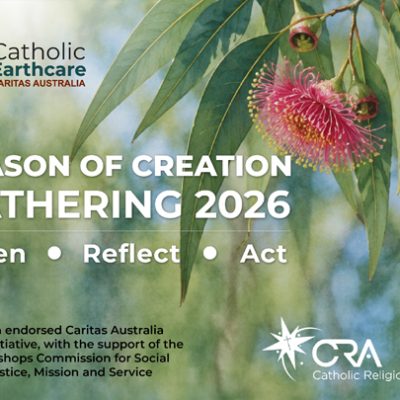
The Catholic Earthcare Season of Creation online gathering last week explored how Indigenous wisdom, ecological justice and synodal listening can help shape the Church’s response to today’s environmental and social challenges. Source: Melbourne Catholic.
Endorsed by Caritas Australia and supported by the Bishops Commission for Social Justice, Mission and Service in partnership with Catholic Religious Australia, the event aimed to deepen formation in integral ecology and inspire practical action grounded in faith.
The opening day invited participants to listen to First Nations voices and to communities bearing the weight of social and environmental change.
From there, speakers reflected on the demands of ecological conversion and the interconnectedness of care for people and planet, then turned to practical ways Catholic communities can respond.
The gathering began with a conversation on caring for Country led by the Broome Bishop Timothy Norton SVD, with Yawuru and Gija woman Erica Bernard of Catholic Education Western Australia, and Nyikina elder and chair of the National Aboriginal and Torres Strait Islander Catholic Council, Shirley Quaresimin.
Ms Bernard spoke of her connection to Country in the Kimberley, Western Australia. Caring for Country, she said, begins with recognising its sacredness.
“I think my cultural understanding in caring for our Country and our common home is deeply rooted in our being, where we were born, and how sacred this place is for our people,” she said, likening the feeling to what a non-Indigenous Catholic may experience on entering a cathedral.
Those are places that hold the spirits and stories of ancestors, and of the responsibility to pass Aboriginal knowledge – shaped by close attention to Country – down to younger generations.
“We’re all on this journey of sharing,” Ms Bernard said. “If people would allow us to share.”
Ms Quaresimin reflected on the symbiotic relationship between her Aboriginal and Catholic identities.
“I live in two cultures: my Aboriginal spirituality and my Catholic faith,” she said.
Explaining her “very strong connection” to Country, Ms Quaresimin said water is central to the life of her people and to the health of the whole ecosystem. The Fitzroy River, which flows through the Kimberley, provides food and shelter for people and animals.
The conversation also explored how people from other places can form respectful relationships with the Country where they now live.
Ms Quaresimin encouraged participants to seek out First Nations people in their local communities, sit down with them and accompany them on a journey of truth-telling.
FULL STORY
Listening to Country, caring for our common home (Melbourne Catholic)