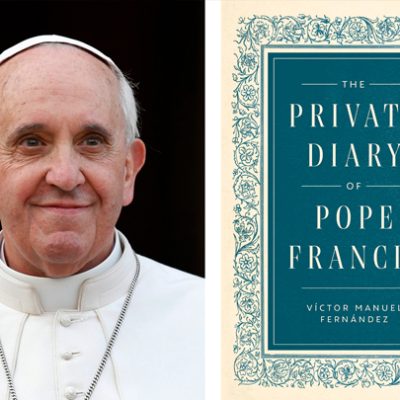
Cardinal Víctor Manuel Fernández, prefect of the Dicastery for the Doctrine of the Faith, has explained how the book of Pope Francis’s personal diary came about. Source: EWTN News.
Pope Francis pointed to an appointment book lying beside three documents on his desk at Casa Santa Marta and gave the cardinal an assignment: When the time came, he should examine what might be useful for the “edification” of others.
That private conversation was the origin of The Private Diary of Pope Francis, which was published yesterday in in five languages.
Cardinal Fernández said Pope Leo XIV’s intervention also made the publication possible: he located the writings and sent them to him.
Upon reading Francis’s handwritten notes, Cardinal Fernández discovered a dimension of the Argentine pontiff’s interior life that, he said, even he had not known.
“I myself, when I opened the box and read the diary, was surprised, I was shocked, because it contained things I had never heard before,” he said. “Not gossip, but facts essential to a firsthand understanding of Francis as a person and of his soul.”
After Leo XIV’s election in May 2025, the cardinal initially preferred not to bother him with the matter. However, months later he said he began to worry about the fate of those papers: where they were, whose hands they might end up in, or whether they might disappear altogether.
“So I went to tell Pope Leo about that conversation and to tell him that I felt obliged to carry out what Francis had asked of me,” he recalled.
“Pope Leo showed an interest, and two days later he found the box containing all the texts Francis had shown me. And Pope Leo sent me the box immediately so that I could do that work.”
The book contains entries spanning from December 20, 1992, to August 18, 2024, organised by theme and accompanied by Cardinal Fernández’s commentary. It is therefore not a complete chronological reproduction of the diary.
The prelate explained that he excluded practical reminders, repetitions, and passages dealing with the private affairs of living individuals that, in his judgment, Francis himself would not have wished to make public.
He also found sections written with “strange signs, like hieroglyphics,” which he interpreted as an indication that the pope did not want others to read them.
However, he insisted that he did not shy away from difficult material: “In reality, the book contains everything worthwhile, even some very provocative and unsettling things, without hiding anything.”
FULL STORY
Cardinal Fernández explains how the book of Pope Francis’ diary came about (EWTN News)