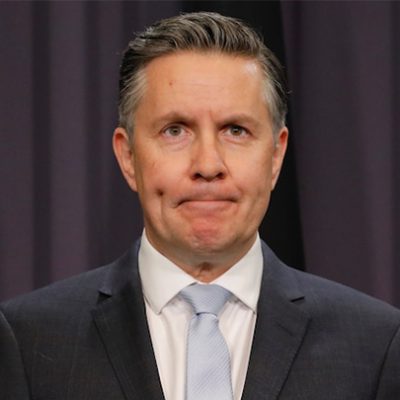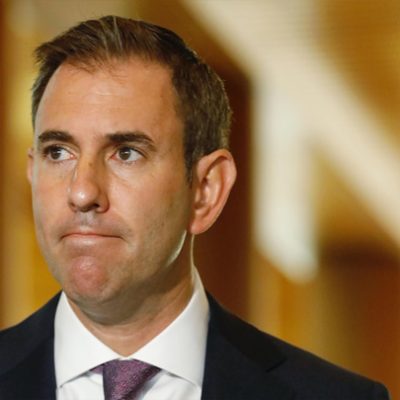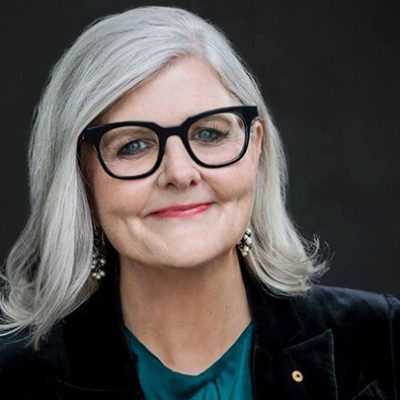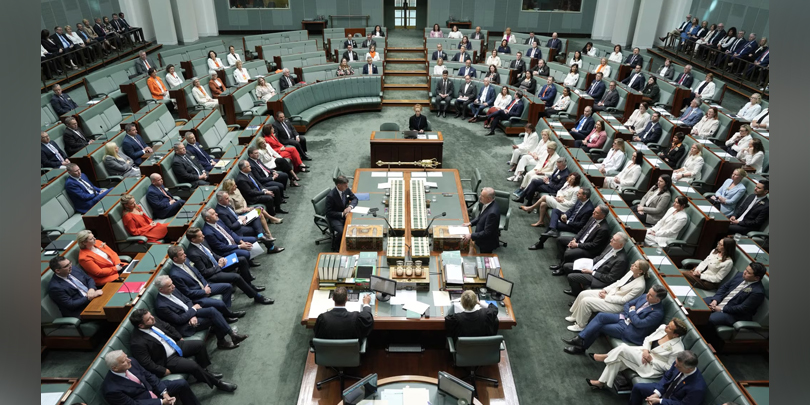
A week after independent MP Helen Haines was deliberately struck by a car outside her office, federal MPs yesterday stood to share their reflections on Ms Haines and improving the public discourse in Australia. Source: Sydney Morning Herald.
Last week’s rare act of violence against one parliamentarian has prompted the rest of them to interrogate what’s holding Australia’s democracy together, what’s threatening it and what role we all play in that dynamic.
Not everyone had the answer – their diagnoses for rising violence spanned online polarisation, male aggression, media hostility, political language, poor mental health services – but there was one point on which all MPs agreed. If anyone modelled the type of person to maintain a respectful but robust public square, it was Ms Haines.
To honour that, women MPs dressed in suffragette white or the same shade of orange as Ms Haines’ cockatoos. Men wore lapel pins with orange hearts or floral arrangements.
“In this place where we often disagree, Helen has always shown that respect and courtesy go hand in hand,” said Speaker of the House Milton Dick.
“There is much discussion on how we as a parliament can work on showing respect to one another. Today I can say this is a moment for all of us to rise to the challenge.”
Central to that debate is how much of a role words play inciting violence – and the words uttered by politicians in particular.
Prime Minister Anthony Albanese has spent months talking about “turning down the temperature”. Yesterday he said there was no way to shrug off “the very real rise in anger that distorts and corrodes our public discourse”.
“Enabled by the anonymity and speed afforded by social media, we are seeing rage and aggression increasing,” he said.
“We must not conflate the robustness of Australian democracy with this rising tide of rage … We cannot allow disagreement to become a full stop.”
“It’s been suggested by some that there is a causal connection between robust parliamentary debate and political violence. I disagree with this view. Our democratic system has served us well,” he said.
“Importantly, we debate with adversarial vigour. But we never allow that vigorous parliamentary debate to spill over into violence.”
The antidote, he believed, was to strengthen the system by celebrating Australia more readily.
Monique Ryan, a close friend of Ms Haines, emphasised other points. Male violence was a problem, while global instability and economic insecurity tore at the social fabric.
“All of us in this place bear some responsibility for the corrosion in public discourse. But the media also bears responsibility for turning anxiety into outrage and for amplifying grievance for more clicks,” she said.
FULL STORY
The cardboard cockatoo, the empty seat and a parliament’s reckoning with rage (By Natassia Chrysanthos, Sydney Morning Herald)