What does it take to help someone recognise that God may be calling them to something more? That question was at the heart of the Victorian/Tasmanian Regional Vocation Directors Conference held in Hobart. Source: Hobart Archdiocese.
The two days brought together vocation directors from the archdioceses of Melbourne and Hobart, and the dioceses of Ballarat, Sandhurst and Sale, to discuss how best to accompany young men discerning a call to the priesthood.
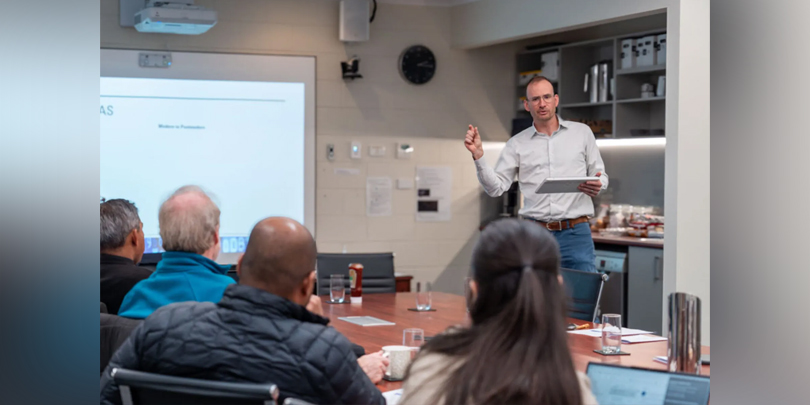
Speaking to those gathered at the conference last month, Hobart Archbishop Tony Ireland reflected on the spiritual foundations of a vocation and the Church’s role in helping people hear God’s call.
Rather than beginning with programs or strategies for finding more candidates, he encouraged vocation directors to consider whether the Church is creating the space that people need to recognise God’s invitation.
“A vocation is not primarily something I choose. It is something I receive,” he said. “Perhaps our first task is not to persuade more young people to consider priesthood. It is to help create a Church in which people can hear God calling.”
Drawing on the wisdom of St Ignatius of Loyola and St Teresa of Avila, Archbishop Ireland spoke of the importance of prayer and silence in helping people become free enough to hear God’s voice.
“Sometimes we ask a young person to discern before we have taught them to pray,” Archbishop Ireland said. “Perhaps the question before that is, have you learned to be silent with Christ?”
He also challenged vocation directors to present priesthood as a beautiful life of self-giving, rather than simply as a role needed to keep parishes operating.
“If we present the priesthood as status, we will attract people interested in status,” he said. “But if we present it as the laying down of one’s life with Christ for his people, something very different happens.”
Guest speaker Brisbane Deacon Peter Pellicaan spoke about engaging young people in an increasingly digital culture.
“The ‘new foyer’ is your website and your socials,” he said, explaining that a person’s first encounter with a parish, diocese or priest may now take place online.
He emphasised that digital communication should ultimately be directed towards real encounter.
“You’ve got to get from the online space into the real presence space, and that’s when things really happen,” he said.
Deacon Pellicaan encouraged vocation directors to speak about why a priest gives his life to Christ, rather than simply describing the work of a priest.
“Young people are not interested in what you do. They’re interested in why you do it,” he said.
FULL STORY
Conference focuses on fostering a culture of vocations (By Heather Excell, Hobart Archdiocese)